

| Country | Germany |
| Population | 239364 |
| Area | 201.03 km2 (77.62 sq mi) |
| Time Zone | UTC+01:00 (CET) |
| Coordinates | 52.13166666666667, 11.639166666666666 |
| Highest elevation | 43 m (141 ft) |
City Gallery




City Description
Magdeburg, a city in eastern Germany, is one of the country’s hidden gems, combining rich history, modern innovation, and a scenic riverside setting. With a population of around 240,000 people, Magdeburg is the capital of the state of Saxony-Anhalt and sits along the Elbe River. As one of Germany’s oldest cities, it has a long history dating back more than 1,200 years, from its time as a medieval center of power to its modern role as a hub for engineering and technology. Despite enduring many challenges throughout its history, including destruction during World War II, Magdeburg has been rebuilt into a vibrant, forward-thinking city.
Historically, Magdeburg was founded in 805 AD and quickly rose to prominence during the reign of Emperor Otto I, who made the city his imperial capital in the 10th century. Otto I, later canonized as Otto the Great, is buried in the city’s most iconic landmark, the Magdeburg Cathedral. The cathedral, built in the Gothic style, is one of the tallest in Germany and remains a symbol of the city’s medieval power. During the Middle Ages, Magdeburg was an important member of the Hanseatic League, a powerful economic and defensive alliance of merchant guilds. However, the city’s fortunes changed during the Thirty Years’ War, when it was nearly destroyed by fire in 1631 during the Sack of Magdeburg.
The devastation of World War II also left a significant mark on Magdeburg, with much of the city being reduced to rubble due to Allied bombing raids. However, since the end of the war, the city has been steadily rebuilt, and today, Magdeburg stands as a city that blends its historical landmarks with modern infrastructure and innovative industries.
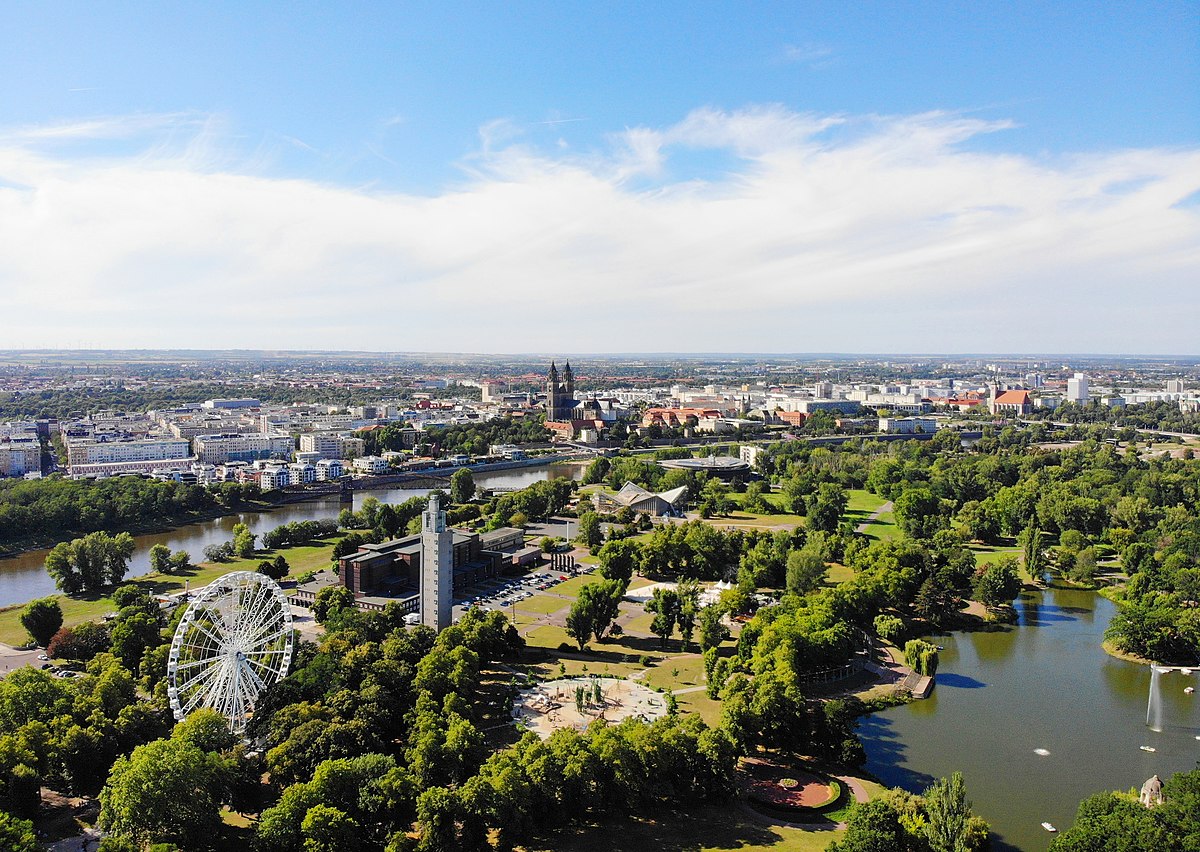
Geographically, Magdeburg is located in the central part of Germany, about 150 kilometers west of Berlin. The city sits on both banks of the Elbe River, which provides a stunning backdrop for Magdeburg’s parks and promenades. Covering an area of approximately 201 square kilometers, Magdeburg enjoys a continental climate with cold winters and warm summers. Average winter temperatures range from -2°C to 4°C, while summer temperatures can reach up to 25°C. The Elbe River also plays a crucial role in transportation and trade, making Magdeburg a key inland port and logistics center.
Culturally, Magdeburg has much to offer, with a diverse array of events, festivals, and artistic performances throughout the year. The city is home to the Magdeburg State Opera, which offers both classical and contemporary performances, and the Schauspielhaus Magdeburg, a major theater that draws audiences from across the region. The city’s love for music is further evident in its annual Telemann Festival, named after the famous Baroque composer Georg Philipp Telemann, who was born in Magdeburg. The festival celebrates classical music and attracts visitors from all over Europe.
One of Magdeburg’s most unique cultural landmarks is the Green Citadel of Magdeburg (Grüne Zitadelle), a whimsical pink building designed by Austrian artist Friedensreich Hundertwasser. Completed in 2005, this quirky architectural masterpiece stands in stark contrast to the city’s older, more traditional buildings and reflects Magdeburg’s blend of history and modern creativity.
In terms of human resources, Magdeburg benefits from its position as an educational center in Saxony-Anhalt. The city is home to the Otto von Guericke University, named after the famous physicist and inventor who was also a mayor of Magdeburg in the 17th century. The university, with around 14,000 students, is well-known for its programs in engineering, natural sciences, and economics. The presence of the university has helped Magdeburg develop a highly skilled workforce, particularly in technical fields, and has fostered close ties between academia and industry. Magdeburg is also home to the Magdeburg-Stendal University of Applied Sciences, which offers a range of practical, career-oriented degree programs.
The economy of Magdeburg is driven by a combination of traditional industries and modern sectors. Historically, the city has been a center for mechanical engineering and heavy industry. Today, Magdeburg remains an important hub for manufacturing, with companies in sectors such as machinery, automotive parts, and steel production operating in the city’s industrial zones. The production of wind turbines and other renewable energy technologies has also become an increasingly important part of the city’s industrial base.
In recent years, Magdeburg has made significant strides in becoming a center for research and development in the fields of mechanical engineering, robotics, and renewable energy. The city’s scientific community is supported by several research institutions, including the Fraunhofer Institute for Factory Operation and Automation and the Leibniz Institute for Neurobiology. These institutions contribute to Magdeburg’s growing reputation as a hub for innovation, particularly in the area of automation and cutting-edge technologies.
The city’s strategic location along the Elbe River has made it a key player in logistics and transportation. Magdeburg is connected to Germany’s major transportation networks, including the autobahn and rail systems, which provide easy access to other major cities like Berlin, Leipzig, and Hanover. The city’s inland port is one of the largest in Europe and plays a crucial role in shipping goods between central Germany and international markets. Magdeburg’s location makes it an important crossroads for both trade and commerce.
Tourism is another growing sector in Magdeburg’s economy. The city’s rich history, impressive landmarks, and vibrant cultural scene draw visitors from around the world. Magdeburg’s attractions include its many historical churches, such as the Magdeburg Cathedral and St. John’s Church, as well as its beautiful parks and gardens, including the Elbauenpark, which offers an expansive green space with gardens, play areas, and the Jahrtausendturm (Millennium Tower), a unique 60-meter-high wooden structure that explores the history of human innovation. The city’s location on the Romanesque Road, a tourist route showcasing Germany’s medieval architecture, also makes it a popular stop for history enthusiasts.
Magdeburg’s infrastructure is well-developed, with excellent public transportation options, including trams, buses, and regional trains that connect the city to other parts of Germany. The city is also served by Magdeburg-Cochstedt Airport, though larger international airports, such as Berlin Brandenburg Airport, are easily accessible by road and rail. Public services in Magdeburg are of a high standard, with the city government focused on sustainability and urban development. Magdeburg is known for its green initiatives, including efforts to expand cycling infrastructure and promote renewable energy in both residential and industrial sectors.
Despite its progress, Magdeburg faces some economic challenges, particularly in terms of unemployment, which remains slightly higher than the national average. The city’s post-reunification transition from an industrial-based economy to a more diversified one has been gradual, but efforts to attract investment and foster innovation are paying off. Magdeburg’s role as a growing tech hub and its focus on sustainable development indicate a promising future for the city.
Overall, Magdeburg is a city that has successfully combined its rich historical heritage with a forward-looking approach to modern industry, education, and culture. Whether you’re exploring the Gothic architecture of the cathedral, visiting its high-tech research institutes, or simply strolling along the scenic Elbe River, Magdeburg offers a unique blend of old and new. Its strategic location, innovative economy, and vibrant cultural scene make it a dynamic city that is both deeply rooted in history and firmly focused on the future.
Leave a Reply