


| Country | China |
| Population | 12600574 |
| Area | 7,567 km2 (2,922 sq mi) |
| Time Zone | UTC+8 (China Standard) |
| Coordinates | 34.75778, 113.64861 |
| Highest elevation | None |
City Gallery




City Description
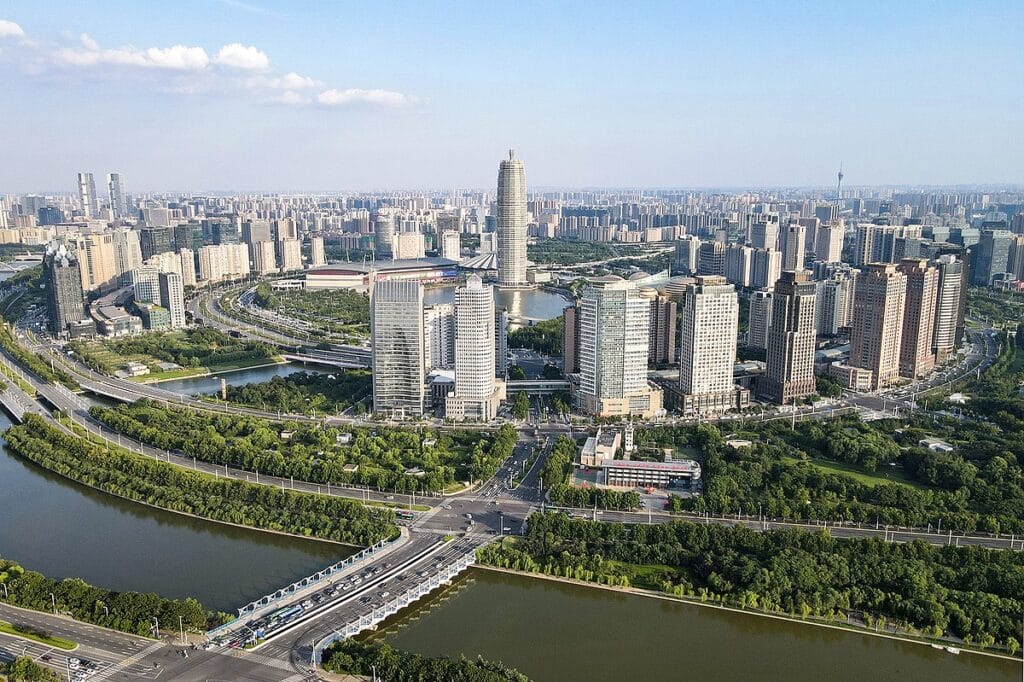
Zhengzhou, the capital and largest city of Henan Province in central China, is a bustling metropolis with a population of approximately 12 million people as of 2020. This vibrant city is located in northern Henan, strategically positioned along the Yellow River. Known for its role as a National Central City, Zhengzhou is a pivotal hub for political, economic, technological, and educational activities in the region.
With an elevation of about 122 meters (400 feet), Zhengzhou sits on the Central Plains, making it a crucial point for both historical and modern transportation routes. The city has a total area of around 744 square kilometers (287 square miles) and is part of the Central Plains Economic Zone, which includes the nearby city of Kaifeng.
Historically, Zhengzhou boasts a rich heritage dating back to ancient times. It was an early capital of the Shang Dynasty, with archaeological finds such as the ruins of the ancient Shang capital, Yin, revealing its importance as a center of early Chinese civilization. The city’s history as a political and cultural center continued through the centuries, cementing its status as a significant historical site.
Geographically, Zhengzhou is surrounded by fertile plains that support extensive agriculture, particularly wheat and cotton production. The city’s climate is characterized as humid subtropical, with hot, humid summers and cold, dry winters. This climate supports a diverse range of plant and animal life and contributes to Zhengzhou’s role as an agricultural hub.
Culturally, Zhengzhou is a melting pot of traditional and modern influences. The city is renowned for its historical landmarks, including the Henan Museum, which houses extensive collections of artifacts from various Chinese dynasties. Zhengzhou is also home to several important Buddhist temples, such as the Shaolin Temple, located nearby in Dengfeng. The city’s cultural scene is vibrant, with numerous festivals, traditional performances, and local crafts that reflect its deep historical roots.
In terms of human resources, Zhengzhou is a significant educational center with several universities and research institutions. Zhengzhou University, one of the prominent higher education institutions in the city, offers a wide range of programs and contributes significantly to research and innovation. The city’s educational system supports a highly skilled workforce, crucial for its industrial and technological sectors.
Economically, Zhengzhou is a powerhouse in the Central Plains Economic Zone. The city has seen rapid growth in recent decades, driven by its strong manufacturing sector, including industries such as electronics, textiles, and machinery. Zhengzhou’s strategic location has made it a key transportation hub, with a major railway station and an international airport facilitating both domestic and international trade. The Zhengzhou Commodity Exchange is one of the key players in the commodities market, further boosting the city’s economic profile.
Zhengzhou is also recognized for its role in the Belt and Road Initiative, reflecting its growing importance in global trade and logistics. The city has been investing heavily in infrastructure and technology to enhance its connectivity and economic competitiveness.
Overall, Zhengzhou is a dynamic city that blends ancient history with modern growth. Its strategic location, cultural heritage, and economic vitality make it a crucial player in both regional and national contexts, continuing to develop as a leading city in central China.
Leave a Reply