


| Country | Iraq |
| Population | 1792000 |
| Area | 180 km2 (70 sq mi) |
| Time Zone | UTC+3 (AST) |
| Coordinates | 36.34, 43.13 |
| Highest elevation | 223 m (732 ft) |
City Gallery





City Description
Al-Mawsil, known internationally as Mosul, is one of Iraq’s most historic and culturally rich cities, a place where ancient civilizations left their mark and modern resilience defines its spirit. Situated in northern Iraq along the banks of the Tigris River, Mosul spans about 180 square kilometers and is home to approximately 1.7 million people as of 2023, making it Iraq’s second-largest city after Baghdad. It serves as the capital of Nineveh Governorate and remains a key hub for the country’s history, economy, and cultural identity.
Mosul’s history stretches back millennia, rooted in the ancient Assyrian Empire. Just a short distance away lies the ancient city of Nineveh, once the capital of the Assyrian Empire and one of the greatest cities of its time. Mosul itself rose to prominence in the early Islamic period as a trade center, thanks to its strategic location on major trade routes connecting the East and the West. During the Ottoman era, Mosul was a thriving center of commerce and culture. More recently, the city faced immense challenges during the ISIS occupation and subsequent liberation in 2017, leaving parts of it devastated. Yet, Mosul’s history and resilience remain a source of pride for its people.
Geographically, Mosul sits on a fertile plain along the Tigris River, surrounded by rolling hills and the Zagros Mountains to the east. This location has historically supported agriculture, with wheat and barley fields dotting the region. The city experiences a semi-arid climate, with scorching summers where temperatures can exceed 45°C and mild winters with occasional rainfall. The Tigris River, a lifeline for the city, provides irrigation for crops and has been central to Mosul’s development for centuries.
Culturally, Mosul is a melting pot of ethnicities and religions, including Arabs, Kurds, Assyrians, Turkmen, and Yazidis. This diversity has shaped its traditions, cuisine, and architecture. Before recent conflicts, the city was known for its vibrant arts scene, music, and festivals. Landmarks like the Great Mosque of al-Nuri, with its iconic leaning minaret (Al-Hadba), symbolized Mosul’s historical significance. The city also has a rich literary and intellectual heritage, often referred to as the “Pearl of the North” for its contributions to Iraqi culture and scholarship.
The people of Mosul, despite enduring years of hardship, are known for their resilience and determination. Human resources in the city have been a mix of traditional skills, particularly in agriculture and crafts, and modern professions in education, healthcare, and trade. Mosul University, one of Iraq’s largest universities, continues to play a vital role in educating the next generation, even as it rebuilds from the damage caused during the war.
Economically, Mosul has historically been a center for agriculture, trade, and industry. The fertile lands surrounding the city produce wheat, barley, fruits, and vegetables, while the nearby oil fields have contributed to Iraq’s energy sector. Mosul was once known for its thriving textile and cement industries. The city’s markets, such as the old Souk Al-Mawsil, were famous for their spices, fabrics, and handicrafts. However, the war significantly disrupted economic activity, and rebuilding efforts have been slow but steady, focusing on restoring infrastructure, markets, and industries.
Infrastructure in Mosul has been a mix of historical charm and modern development, though much of it was heavily damaged during the conflict with ISIS. The Tigris River bridges, vital for connecting different parts of the city, have been rebuilt or repaired, symbolizing Mosul’s resilience. Public transportation primarily consists of buses and taxis, while narrow streets in the old city are often best navigated on foot. Reconstruction efforts have prioritized schools, hospitals, and housing, but challenges remain in fully restoring the city.
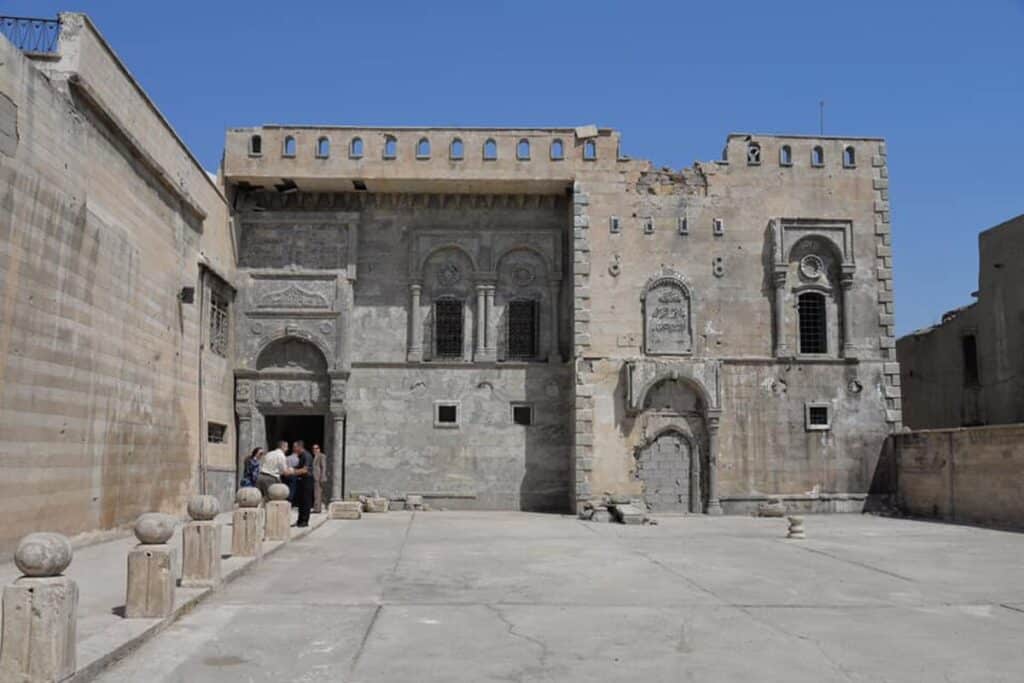
Landmarks in Mosul highlight its historical and cultural importance. The ruins of Nineveh, just outside the city, are a UNESCO World Heritage site, featuring ancient Assyrian walls, gates, and palaces. Within Mosul, the rebuilt Al-Nuri Mosque and its leaning minaret remain iconic, alongside other historic sites like the Tomb of Jonah (Nabi Yunus) and Al-Tahira Church, reflecting the city’s multi-religious heritage. The old city, with its labyrinth of alleys and traditional houses, is a testament to Mosul’s rich past.
Food in Mosul is a reflection of its cultural diversity and agricultural abundance. Traditional dishes like kubbeh mosul (stuffed semolina dumplings) and masgouf (grilled fish) are local favorites. The city’s sweets, such as zalabiya (fried dough soaked in syrup) and baklava, are popular treats. Local markets are filled with fresh produce, spices, and bread, while tea houses serve as gathering spots for socializing and storytelling.
Mosul is a city of contrasts—ancient yet modern, scarred yet hopeful. Its people, culture, and history stand as symbols of resilience in the face of adversity. Whether exploring its archaeological treasures, strolling along the Tigris, or engaging with its warm and hospitable residents, Mosul offers a glimpse into the soul of Iraq, a city rebuilding itself with determination and pride.
Leave a Reply